
As anyone knows, the last ten years I have had this special interest and hyperfocus on the predictive coding perspective on autism. My book on the predictive brain in autism already sold 10.000 copies in the original Dutch version and it is running well in the other languages as well.
In that book I limited my writings to the predictive coding perspective on sensory issues, communication and social challenges in autism.
Recently I have further explored how the predictive coding will help us to get a better understanding of other interesting areas as well. In a previous blog post, I wrote about the predictive dynamics of well-being.
In the last couple of months I have been invited a few times to talk about emotions and emotion regulation in autism. I have developed a whole new presentation on “Why the popular emotion thermometers do not always work” and why we actually should not use them in most cases.
All of this is linked to a renewed understanding of emotion regulation offered by the predictive coding perspective.
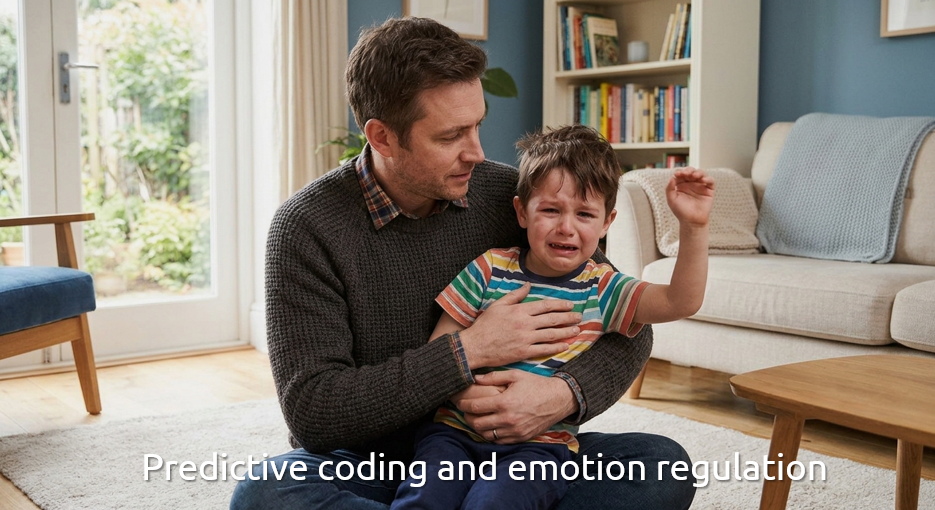
Emotion regulation is one of the places where predictive coding doesn’t just add color to existing strategies — it offers a genuinely different causal story for why certain neurodivergent children struggle with emotion regulation, which changes what “regulation” should even target.
The relevant theory: unusual precision-weighting
The dominant predictive-coding account of autism proposes that autistic perception involves overly precise, poorly attenuated prediction errors — combined with weaker or more inflexible top-down priors in some contexts. In plain terms: the brain doesn’t discount small or expected fluctuations the way a neurotypical brain does. Every mismatch between prediction and incoming sensory/interoceptive signal is treated as highly informative and demanding of attention, rather than being smoothed over.
Applied to interoception, this means: ordinary bodily fluctuations (a shift in heart rate, a change in room noise, hunger, a transition between activities) generate disproportionately large, un-dampened prediction errors.
What looks like “overreacting” is, mechanistically, a nervous system that cannot deprioritize noise the way most brains automatically do.
What this changes about current strategies for emotion regulation
Many mainstream emotion-regulation approaches (structured SEL curricula, some CBT-based programs) assume a fairly intact pipeline: sense the body → label the feeling → apply a coping strategy. Predictive coding suggests this pipeline can break down earlier than assumed — at the level of raw prediction-error volume, before labeling even happens. That reframes several things:
- “Meltdowns” as accumulated, undischarged prediction error, not defiance or poor coping-skill application. This is worth explicitly communicating to parents/teachers — it shifts the frame from behavior management to nervous-system load management.
- Emotion-labeling-first approaches (e.g., “use your words,” feelings charts) may be premature for children whose bottom-up signal is already overwhelming — you’re asking for a high-level cognitive operation while the system is drowning in low-level error. Interoceptive groundwork often needs to come before verbal labeling.
- Alexithymia (common in autism) isn’t a motivation problem — under this model it can reflect genuinely noisy or imprecise interoceptive predictions, making it hard to build a stable mapping between bodily states and emotion concepts in the first place.
Practical recommendations that follow
- Reduce ambient prediction-error load, don’t just address the “trigger.” Predictable routines, visual schedules, and advance warning of transitions aren’t just comfort measures — they function as strong priors that reduce the volume of error signals the child has to process. Consistency is doing real computational work here, not just providing emotional security.
- Build interoceptive literacy directly and bottom-up, separately from emotional vocabulary. Techniques like body-mapping (“where do you feel it”), heartbeat-noticing games, or simple biofeedback exercises train the precision and reliability of internal predictions themselves — arguably more foundational than teaching the word “angry.”
- Titrate sensory environments rather than expecting habituation. Since prediction errors aren’t being automatically down-weighted, repeated exposure to a loud environment may not produce the same desensitization it would in a neurotypical child. Environmental modification (noise reduction, lighting, predictable seating) is treating a real computational difference, not “accommodating avoidance.”
- Introduce novelty and change incrementally and predictably, rather than either over-scheduling rigid sameness or forcing abrupt exposure. The goal is gradually building flexible, well-calibrated priors — not eliminating change, and not flooding the system either.
- Use co-regulation as external precision-correction. A calm, predictable adult nervous system nearby (steady voice, slow movements, consistent response) can act as an external prior that helps recalibrate an overwhelmed system — this is consistent with existing co-regulation practice, but the predictive-coding lens explains mechanistically why consistency of the adult’s affect matters so much, not just its warmth.
- Address the aftermath, not just the trigger, as data for model-updating. After a dysregulated episode, calmly walking through what happened can help the child’s brain revise misaligned predictions about a specific context (“last time, loud cafeteria + hunger = overwhelm”) — turning the event into useful model-updating rather than just something to move past.
What this doesn’t override
This framework is a mechanistic account, not a replacement for evidence-based practice — many current interventions (visual supports, sensory diets, co-regulation, gradual exposure) remain well-supported independent of predictive coding and would be recommended anyway.
What predictive coding mainly changes is the justification and sequencing: it argues for interoceptive-first rather than label-first regulation training, reframes rigidity and meltdowns as computational rather than behavioral, and gives a principled reason why environmental predictability isn’t just “nice to have” but is doing real regulatory work. It’s still an active research area, so it’s best treated as a useful theoretical lens to combine with individualized clinical guidance rather than a wholesale replacement for it.