
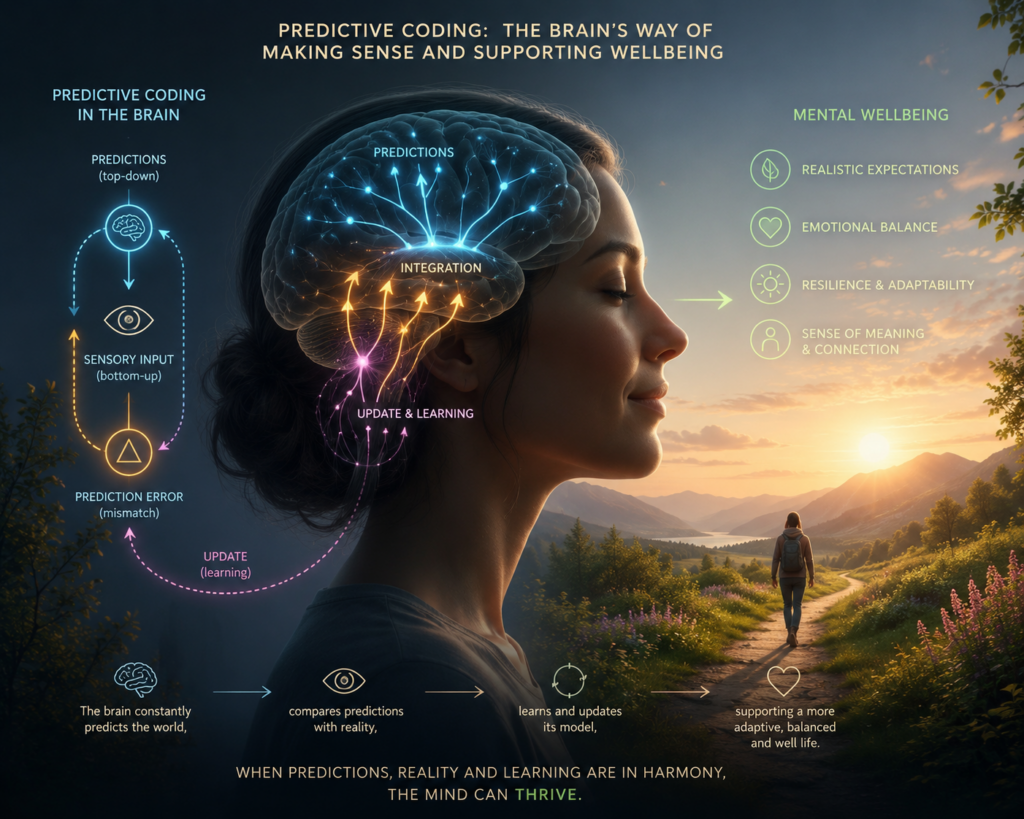
Predictive coding theory—often framed within the broader “predictive processing” paradigm—offers a compelling lens for understanding mental health and well-being. At its core, the theory proposes that the brain is not a passive receiver of information, but an active prediction machine: it continuously generates expectations (priors) about the world and updates them based on incoming sensory input by minimizing “prediction errors.”
Until now, most of my work has been on using the predictive coding framework for a better understanding of autism. My book on autism and the predictive brain has received quite some attention and interest and is now available in 5 languages. However, my interest in predictive coding is not limited to autism.
Because of all my work on well-being in autism (which resulted in the H.A.P.P.Y.-programme), I also use predictive coding to explore strategies that enhance mental wellbeing. And this is not restricted to autism, because increasingly it becomes clear that the traditional classifications and diagnoses are not really helpful for supporting people. A transdiagnostic approach focusing on mechanisms that influence well-being (both in a negative and a positive way) across diagnostic labels will be more informative for developing strategies to support people who struggle with mental health issues, such as anxiety, stress, burn-out and depression.
From a predictive coding perspective, mental health depends on how well the brain’s internal models align with reality. When this system functions effectively, individuals can flexibly update beliefs, adapt to changing environments, and regulate emotions. However, disruptions in this inferential process can lead to stress, mental dysregulation and even psychopathology.
For example, in depression, predictive coding accounts suggest that overly rigid negative beliefs (priors) dominate perception and learning. Individuals may expect failure or lack of reward, and these expectations bias how they interpret new information. At the same time, abnormalities in processing prediction errors – especially reward-related signals – can prevent these beliefs from being updated, reinforcing symptoms like anhedonia and pessimism.
More broadly, computational psychiatry frames mental conditions as dysfunctional differences in hierarchical prediction systems, where either prior beliefs are too strong (rigid) or sensory evidence is underweighted (or vice versa) or where there is an imbalance in the contextualized and flexible weighting of prior beliefs and sensory evidence. This imbalance can manifest across conditions such as autism, anxiety, psychosis, and depression.
Well-being as successful prediction
Predictive coding also provides a positive account of well-being. Rather than defining mental health simply as the absence of mental health issues, it conceptualizes well-being as the capacity for adaptive, flexible prediction and error correction.
A key insight is that emotional experience (valence) can be understood in terms of prediction error dynamics, that is, whether the brain is successfully reducing uncertainty over time. When prediction errors decrease efficiently, individuals experience positive affect and a sense of control. Conversely, persistent or increasing errors are associated with stress and negative affect.
In this view, well-being emerges when:
- Internal models are flexible and revisable and hence adaptive to changing environments;
- The system can learn from errors without becoming destabilized;
- Actions effectively reduce uncertainty in the environment.
This aligns with everyday experiences: curiosity, learning, and meaningful engagement tend to enhance well-being because they support adaptive prediction and learning.
Implications for support and interventions
Understanding mental health through predictive coding has important practical implications:
- Psychotherapy can be seen as a process of updating maladaptive priors (e.g., cognitive restructuring in CBT) and offering priors that result in a reduction of unpleasant prediction errors and errors with negative valence.
- A social network with people we trust can help us to mirror our priors against those of the people around us and this can help to update priors and recalibrate prediction errors. Being surrounded and supported by people we trust also relaxes the brain, reducing the hyper alertness that leads to overweighing prediction errors.
- Exposure therapies help recalibrate prediction errors by confronting feared expectations with new evidence, obviously ensuring that the person has control and is not forced into activities that increase the anxiety.
- Mindfulness and meditation may reduce overly rigid and negative predictions and increase sensitivity to present-moment sensory input.
- Emerging approaches in computational psychiatry aim to tailor treatments based on specific “predictive dysfunctions.”
Overall, the framework shifts focus from symptoms alone to underlying computational mechanisms, opening the door to more precise and personalized interventions.
Conclusion
Predictive coding reframes mental health as a matter of how the brain models and updates its understanding of the world. Well-being arises when this system is flexible, adaptive, and capable of minimizing uncertainty over time, while mental disorders reflect systematic distortions in these predictive processes. This perspective not only unifies diverse psychological phenomena but also offers a promising foundation for future research and clinical practice.
I am currently working on a (much larger) article with a theoretical review on predictive processing and well-being, drawing on some pivotal scientific publications on the topic.
Key references
As an introduction, here are some recent publications linking predictive coding to mental health and well-being:
Miller, M., Kiverstein, J., & Rietveld, E. (2021). The Predictive Dynamics of Happiness and Well-Being.
Shaw, A. D., Sumner, R. L., & Berndt, L. C. S. (2025/2026). Predictive coding and neurocomputational psychiatry: a mechanistic framework for understanding mental disorders.
Gilbert, J. R., Wusinich, C., & Zarate, C. A. (2022). A Predictive Coding Framework for Understanding Major Depression.
Van de Cruys, S., & Van Dessel, P. (2021). Mental distress through the prism of predictive processing theory.